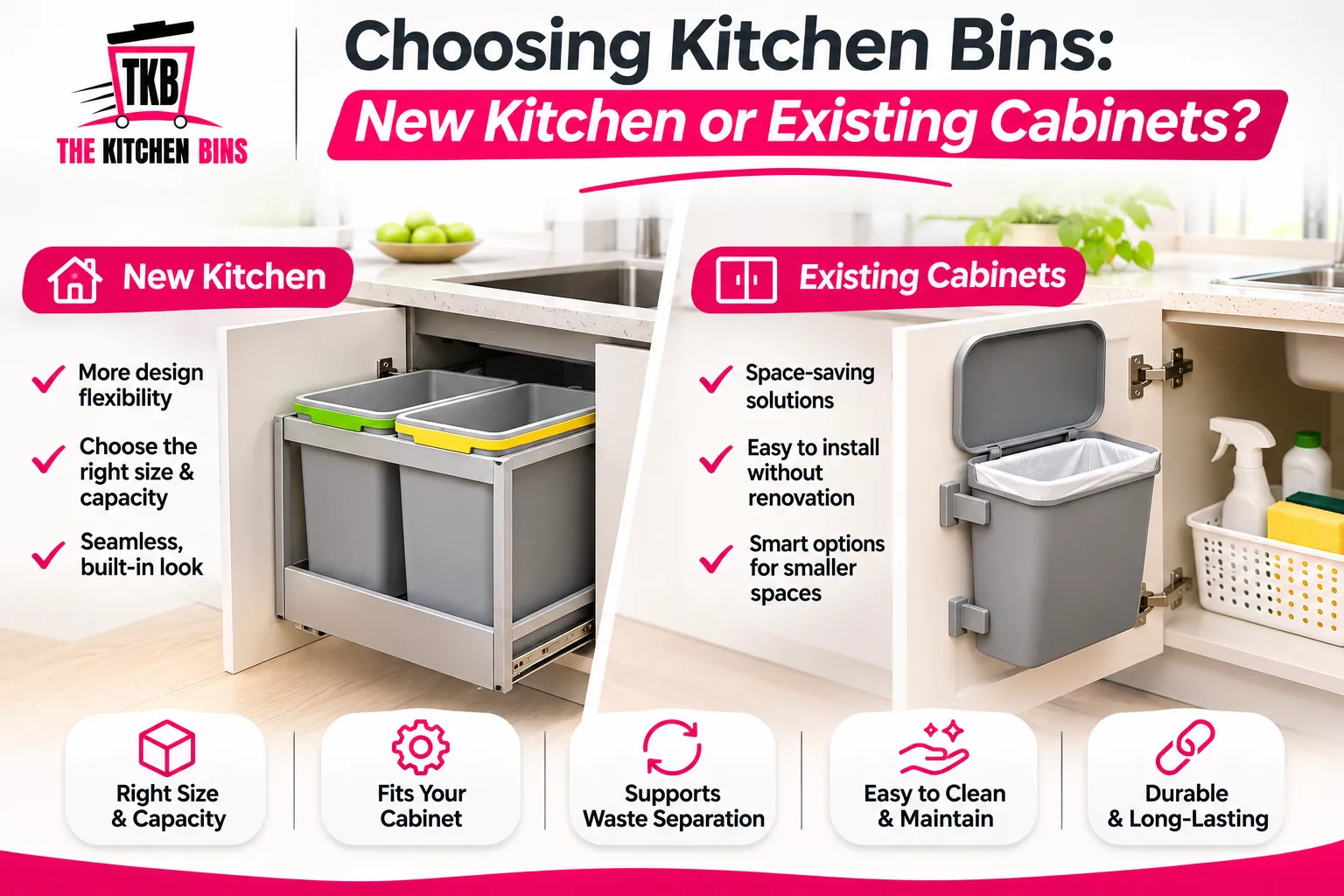
Ask a kitchen designer where the bin should go, and their first question is usually whether you’re building a new kitchen or working with the one you have. That single answer narrows the choice of kitchen bins more than size, colour or brand ever will.
A renovation lets you plan the bin into the cabinetry from day one. An existing kitchen means finding a bin that suits the cupboards already in place. Both can give you a tidy, hidden waste system. They just get there by different routes.
Why Your Starting Point Matters
Concealed bins rely on the cabinet around them. Some are built into a drawer and depend on that drawer’s runners. Others sit inside a standard cupboard and fix to the floor, sides or door.
That’s why it pays to work out early which situation you’re in. Choosing a bin before you know what your cabinets can take is how people end up with a beautiful system that won’t fit.
Planning a New Kitchen or Renovation
If new cabinets are on the way, you have the most freedom. This is the best time to consider kitchen drawer bins, which are built into a deep pull-out drawer rather than hidden behind a door.
Opening the drawer brings the whole bin forward, so you can reach every bucket from above without leaning into a cupboard. There’s no door to open first and nothing to swing past, which makes drawer bins easy for the whole household to use.
The catch is that they must match the drawer system. Blum’s TANDEMBOX antaro range, for example, includes bin sets for cabinets from 300mm up to 600mm wide, and Wesco’s Pull Boy Z bin is designed to suit the same drawers. If you’re going down this path, tell your cabinet maker early, so the right drawer hardware and width are allowed for.
A few things to settle at the design stage:
-
Location: close to where you prepare food and rinse plates, but clear of the dishwasher door
-
Width: a wider cabinet allows larger buckets or more compartments
-
Waste streams: how many buckets you need to match what your council collects
Upgrading an Existing Kitchen
Most homes aren’t due for new cabinetry, and that’s fine. An in cupboard bin is designed to go inside a standard base cabinet behind its existing hinged door, so you can hide the rubbish without replacing anything.
There are several ways these bins work:
-
Pull out: the bin slides forward on runners once the door is open
-
Door mounted: the bin hangs from a bracket on the inside of the door
-
Fixed: a bucket sits in a frame on the cupboard floor
Pull out systems are popular because they bring the buckets to you, and twin-bucket models handle general waste and recycling side by side. Door mounted options can suit crowded spaces, such as under the sink, where pipes take up the cupboard floor.
Before buying, measure the cabinet’s internal width, depth and height, not just its nominal size. Side panels, hinges and plumbing all reduce the usable space. Then open the door slowly and check nothing will be in the bin’s way as it moves.
Matching the Bin to How You Sort Rubbish
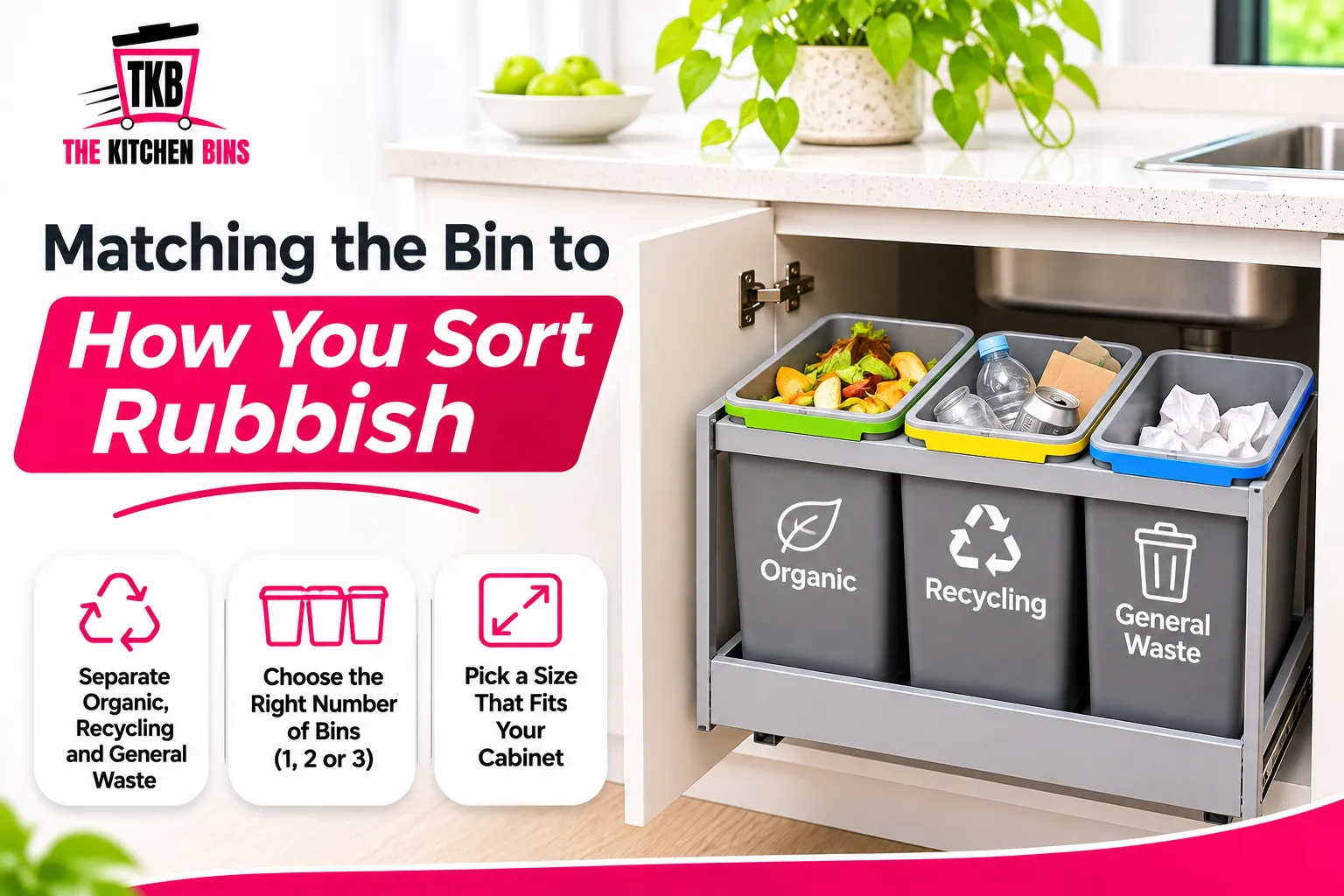
Whichever route you take, the number of buckets should follow your habits.
If most of your waste is general rubbish, one large bucket may be all you need. If you recycle regularly or collect food scraps for a council organics bin, a twin system keeps things sorted without extra bins on the floor.
When comparing twin models, look at the size of each bucket as well as the total. Two smaller buckets are lighter to carry out, but they fill faster. The right balance depends on how often you’re happy to empty them.
Don’t Forget the Long Term
Buckets get the hardest wear. They’re lifted out, washed and knocked about every week, so they usually wear out well before the runners or frame.
Choosing a system with replacement buckets available means a cracked bucket is a small fix, not a reason to replace the whole unit. Removable buckets with smooth inner surfaces are also much easier to keep clean.
Frequently Asked Questions
Can I add a drawer bin to my existing kitchen?
Sometimes, but it’s harder than fitting a cupboard bin. Drawer bins need compatible drawer hardware and a cabinet of the right width. If your kitchen has standard hinged doors, an in cupboard bin is usually the simpler upgrade.
Are in cupboard bins hard to install?
Many are designed for existing cabinets, and simpler models are often a DIY job. Larger pull out systems need accurate fitting, so follow the instructions closely or ask a cabinet maker for help.
Which is better, a drawer bin or a cupboard bin?
Neither suits every kitchen. Drawer bins give easy top access and suit new cabinetry. Cupboard bins come in more styles and work with the cabinets you already have.
How many buckets should my kitchen bin have?
Match the buckets to the waste streams you sort at home. Many households find two buckets, one for general waste and one for recycling, cover their needs.
Why Choose The Kitchen Bins?
-
One specialist range: pull out, door mounted, freestanding and drawer bin systems
-
Shop by cabinet width: filter by 400mm, 450mm, 500mm and 600mm cabinets
-
Trusted brands: Wesco, Kia Ora, Hailo, Häfele, Hideaway and Blum
-
Replacement buckets: spares stocked for selected compatible systems
-
Easy buying: free standard shipping on orders over $200 and a 30-day returns window
About The Kitchen Bins
The Kitchen Bins is part of The Storage Shop, a 100% Australian-owned business that has been helping homeowners since 1992. It was founded by a cabinet maker with more than ten years of experience designing and building kitchens, so the range is organised around real cabinet sizes. Based in Lonsdale, South Australia, The Kitchen Bins delivers kitchen waste solutions across Australia.
